
Industrial reactors
Industrial Reactors in Stainless Steel | High-Performance Engineering and Manufacturing
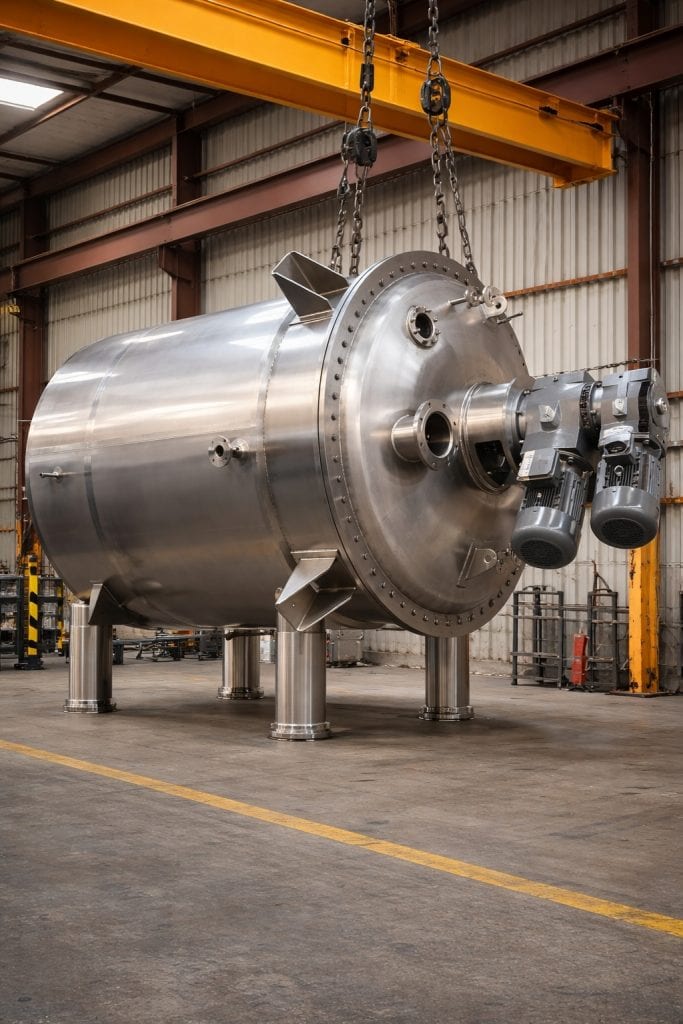
Falco industrial reactors are designed for complex processes requiring precise control of temperature, pressure, heat transfer, and agitation. Manufactured from food-grade, chemical, or pharmaceutical-grade stainless steel, they guarantee safety, efficiency, and reliability in every operation.
With over 30 years of experience and ASME certifications, we produce custom-made reactors, ready to be integrated into chemical, pharmaceutical, cosmetic and food production lines.

Main features
- Manufactured in stainless steel 304L, 316L, Duplex 2205, SuperDuplex or special materials depending on the process.
- Capacities from 100 L to 50,000 L.
- Heat transfer jackets: dimpled, half-pipe, conventional and laser welding.
- Design for pressure and vacuum (ASME VIII Div.1).
- Sanitary interior finish with certified roughness.
- Option of hinged, torispherical or flat lids, depending on the process.
- 3D design and structural analysis by FEA.
Stirring options
Marine propeller
It is a three-bladed, curved agitator that generates a powerful and uniform axial flow. It is used when rapid mixing is required in low- to medium-viscosity liquids. Its design allows for the movement of large volumes with low energy consumption.
Axial flow turbine
It features several straight or angled blades that push the fluid vertically. It is ideal for suspending solids, homogenizing ingredients, and maintaining a consistent mix without dead zones. It is used in chemical, food, and pharmaceutical processes.
Anchor with scrapers
It's a low-speed agitator that sweeps the tank walls to prevent the product from sticking or burning. Scrapers ensure a uniform temperature and are essential for viscous products such as creams, jams, gels, or emulsions.
Dual or triple system
A combination of two or three agitators working together: one high-speed, one low-speed, and one scraper. This allows for the processing of complex products that require different stages of mixing, dispersion, and homogenization within the same batch.
Sanitary or industrial mechanical seals
They prevent leaks between the shaft and the tank. The sanitary version is easy to disassemble and clean, while the industrial version is resistant to harsh chemicals. They are key to ensuring hygiene, operational safety, and preventing product contamination.
Fixed motors or frequency converters
Fixed motors operate at a single speed; variable frequency drives allow the agitator speed to be adjusted according to the stage of the process. This improves control, reduces energy consumption, and prevents overmixing or damage to sensitive products.
Benefits
- Total process control (temperature, pressure, mixing): The design allows regulation of all critical variables to ensure that the batch follows exactly the required conditions, reducing errors and improving quality.
- High thermal and energy efficiency: Jacketed or coiled tanks distribute heat evenly, which speeds up the process and reduces energy consumption.
- Facilitates cleaning and sterilization (CIP/SIP): They are designed so that automatic washing reaches all corners of the tank, guaranteeing hygiene and reducing downtime.
- Minimize batch times: By mixing better, heating faster, and avoiding dead spots, total process times are reduced, increasing productivity.
- Long service life even in aggressive chemical processes: Specialized stainless steel and industrial finishes allow the tank to withstand corrosion, pressure and intensive chemicals for years.
- Full traceability and certification of materials: Each piece has documentation of origin and certifications that guarantee its quality, something essential for regulated industries.
Applications
Endothermic/exothermic chemical reactions:
The tanks control the heat generated or required during the reaction thanks to integrated cooling or heating systems.
Pharmaceutical production:
They comply with strict sanitary standards, allowing the mixing of active ingredients, excipients, and suspensions without risk of contamination.
Cosmetics and personal care:
They process creams, gels, shampoos, and emulsions that require controlled agitation and constant temperatures to maintain stability.
Fermentations and biochemical processes:
They allow control of oxygen, temperature and movement, critical conditions for microorganisms or enzymes.
Food and drinks:
Perfect for sauces, bases, jams, dressings, dairy products and syrups, where absolute hygiene is required.
Adhesives, paints and coatings:
High viscosity systems that require strong mixing, temperature control, and specific agitators.
Types of Industrial Reactors
Industrial reactors are classified according to how the reaction occurs , how the reactants are mixed , and how the process is operated . Each type serves specific applications depending on whether the reactants are in the gaseous, liquid, or solid phase, and the level of control required in the plant.
1. According to the phase of the reagents
a) Reactors for homogeneous reactions
These are reactors where all reactants are in the same phase , either gas-gas or liquid-liquid. There is no phase separation, so the mixture is uniform and the reaction occurs evenly throughout the volume.
Typical applications:
- Chemical synthesis processes
- Liquid reactions where solid catalysts are not used
- Fermentations and homogeneous biological processes
Advantages:
- Easy control of temperature and composition
- Uniform mixture
- Operational simplicity
b) Reactors for heterogeneous reactions
The reactants are in different phases (gas-liquid, liquid-solid, gas-solid, etc.). Mass transfer between phases is key for the reaction to occur.
Typical examples:
- Hydrogenations (gas-liquid)
- Solid-catalyzed reactions (liquid-solid)
- Gas conversion in the presence of catalysts
Advantages:
- They allow the use of catalysts
- Greater efficiency and selectivity
- Widely used in refineries and fine chemicals
2. According to the degree of mixing (flow model)
a) Perfectly mixed reactors (CSTRs)
The contents of the reactor are thoroughly mixed, so the composition and temperature are uniform throughout . The outgoing product has the same composition as the contents.
Typical uses:
- Fermenters
- Neutralization processes
- Liquid reactions with high mixing demand
Advantages:
- Excellent temperature control and stirring
- Ideal for reactions that require constant mixing
b) Plug flow reactors (PFRs)
The reactants flow like a "piston," meaning they advance in a straight line without mixing laterally . Each "section" of the fluid is at a different stage of the reaction.
Typical uses:
- Tubular reactors in petrochemicals
- Continuous processes at high pressure and temperature
Advantages:
- Higher conversion per volume than a perfect mixed reactor
- It allows for rapid reactions and control by residence time
3. According to the method of operation
a) Batch reactors
The reactor is initially loaded, allowed to react, and then unloaded. No material enters or leaves during the process.
Typical uses:
- Small batches
Pharmaceutical - Cosmetics
- Fine chemicals
Advantages:
- Very flexible
- Ideal for high-value products
b) Semi-continuous reactors (Fed-Batch)
They combine batch feeding with progressive feeding:
- It starts as a batch
- Then it is slowly fed with more reagents
Widely used in:
- Biotechnology
- Controlled fermentations
- Sensitive products that inhibit their own growth
Advantages:
- Fine process control
- Higher productivity
c) Continuous reactors
They operate without stopping:
- Reagents are constantly being added
- Product is constantly being released
They remain in a steady state.
Typical uses:
- Petrochemistry
- Fertilizers
- Mass production
Advantages:
- High efficiency
- Lower cost per unit of product
- Stable and predictable operation