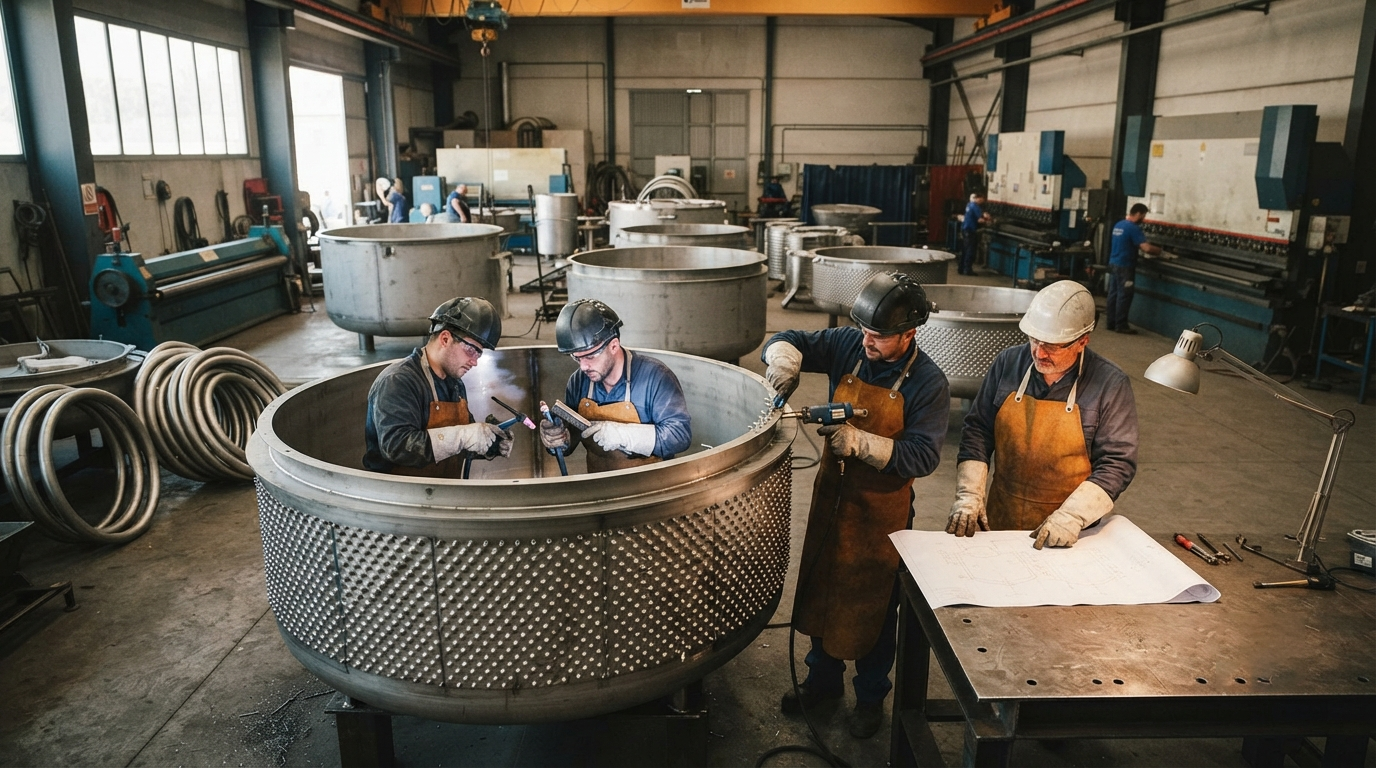
Optimizing heat transfer in a food or cosmetics processing plant requires precise engineering decisions. When a company decides to invest in new heating equipment, the primary technical question usually revolves around the outer jacket design. Therefore, understanding the key differences in industrial kettle manufacturing is the fundamental step to reducing energy costs.
Not all thermal jackets perform equally when exposed to heating media such as steam, hot water, or thermal oil. Below, we break down the three most commonly used jacket designs in the market so you can select the optimal choice for your process.
The Challenge of Thermal Efficiency in the Plant
An incorrect calculation in the heat transfer area leads to unnecessary downtime and fuel waste. For this reason, using an inadequate jacket drastically increases kilowatt-hour or steam-kilogram consumption across the factory floor.
Consumer goods companies need their process fluids to reach target temperatures in the shortest possible time.
Relying on deficient heat exchange systems triggers severe operational issues:
Revenue Loss from Inefficient Heat Dissipation
When an industrial kettle fails to distribute heating media uniformly, cold spots form within the vessel. As a direct consequence, the product batch exits with inconsistent texture or chemical properties, compromising overall batch quality. Furthermore, plant boilers are forced to run on overdrive, driving up general plant maintenance and operational costs.
Technical Comparison: Dimple, Half-Pipe, or Conventional Jacket?
To solve these operational hurdles, industrial project engineers must evaluate vessel geometry based on working pressure and service type. Each jacket design modifies fluid dynamics and mechanical metal resistance, directly determining overall thermal transfer efficiency.
At Falco Latino, we calculate each heat transfer jacket based on process physics and the overall heat transfer coefficient (U-value). We do not weld channels at random; our engineering division custom-configures the metallurgical structure to induce the exact fluid turbulence required by your process.
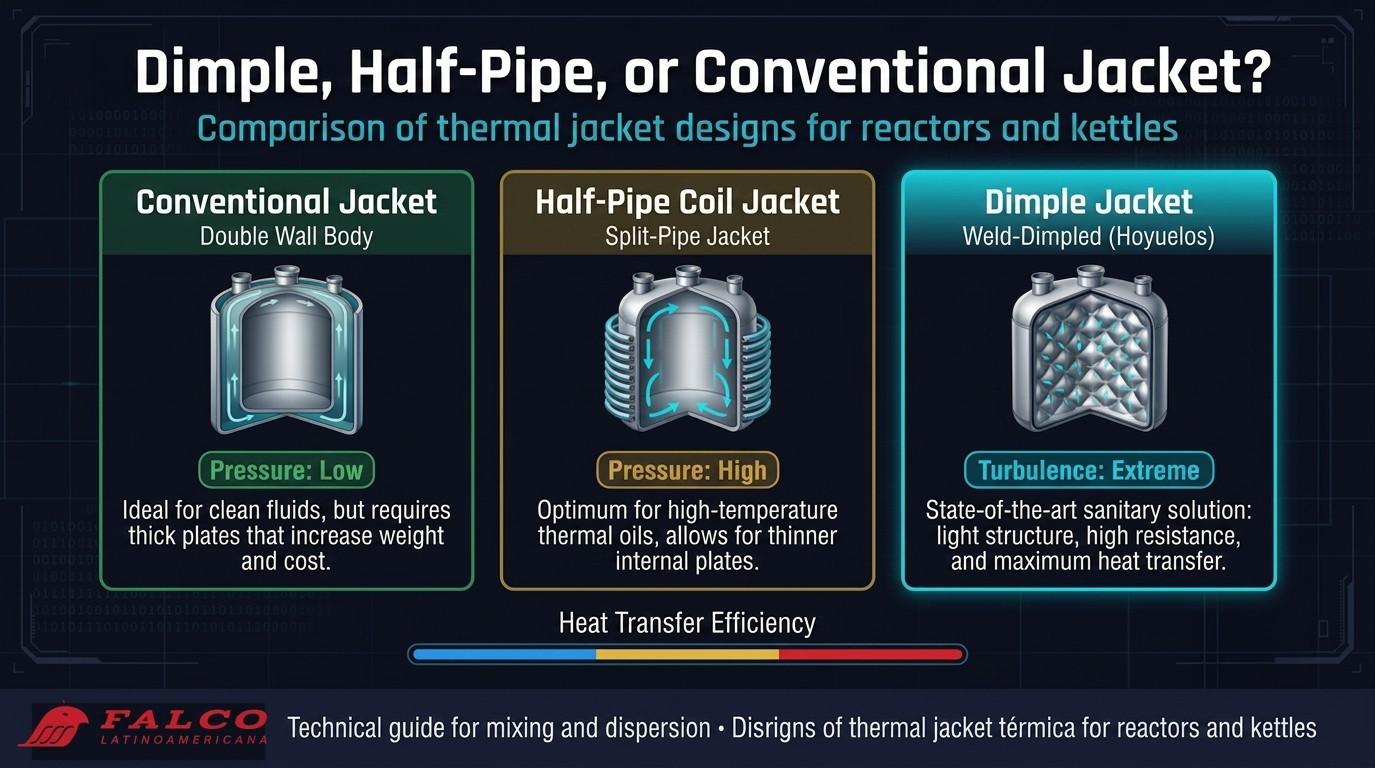
Conventional Jacket (Double Wall)
The traditional design where a second outer wall encapsulates the vessel shell. While ideal for low-pressure applications and clean heating media, it requires heavy shell plate thickness to withstand steam pressure. Consequently, this increases total equipment weight and upfront raw material costs.
Half-Pipe Coil Jacket
Consists of split pipe coils welded around the reactor shell. This design excels in handling high-temperature thermal oils under elevated pressures by guiding flow through defined channels. As a result, thinner inner shell plates can be utilized without compromising the mechanical integrity of the kettle.
Dimple Jacket
Represents a cutting-edge solution for the international sanitary industry. Manufactured using a thin stamped sheet spot-welded to create a 3D pillow pattern, this geometry induces extreme turbulence in the heat transfer fluid, maximizing thermal efficiency within a lightweight yet high-strength structure.
Strategic Solution: Data-Driven Thermal Engineering
Jacket selection must be backed by rigorous analysis of process flow diagrams (PFDs) and raw material properties. Consequently, manufacturing industrial kettles with mathematically engineered jackets delivers a true competitive edge by lowering overall energy consumption.
If your technical team needs to determine optimal dimensions for an upcoming processing line, we invite you to review our industrial kettles and process tanks section. There, you will find detailed information regarding agitation setups and thermal insulation options configured by our engineers.
Likewise, if your plant requires a turnkey solution combining high-viscosity fluid mixing with automated piping and valve networks, you can explore our full product catalog. This ensures every fixed asset in your facility operates under unified standards of hygiene and efficiency.
Your Tactical Partner in Heat Transfer Projects
Modernizing plant heating systems requires backing from metal-fabrication specialists fluent in pressure vessel codes and material science. At Falco Latino, we understand that plant efficiency drives profitability, and our commitment is to supply high-performance engineered assets.
Do not let ballpark estimates compromise performance in your food, cosmetics, or pharmaceutical processing lines. We custom-design each kettle aligned with your exact temperature and pressure parameters, guaranteeing seamless integration with automated Clean-in-Place (CIP) systems.
Contact us today to schedule a technical session with our engineering team. Request a customized quote for your processing plant or submit your design drawings so we can co-develop the precise industrial equipment to boost your productivity, safety, and yield.