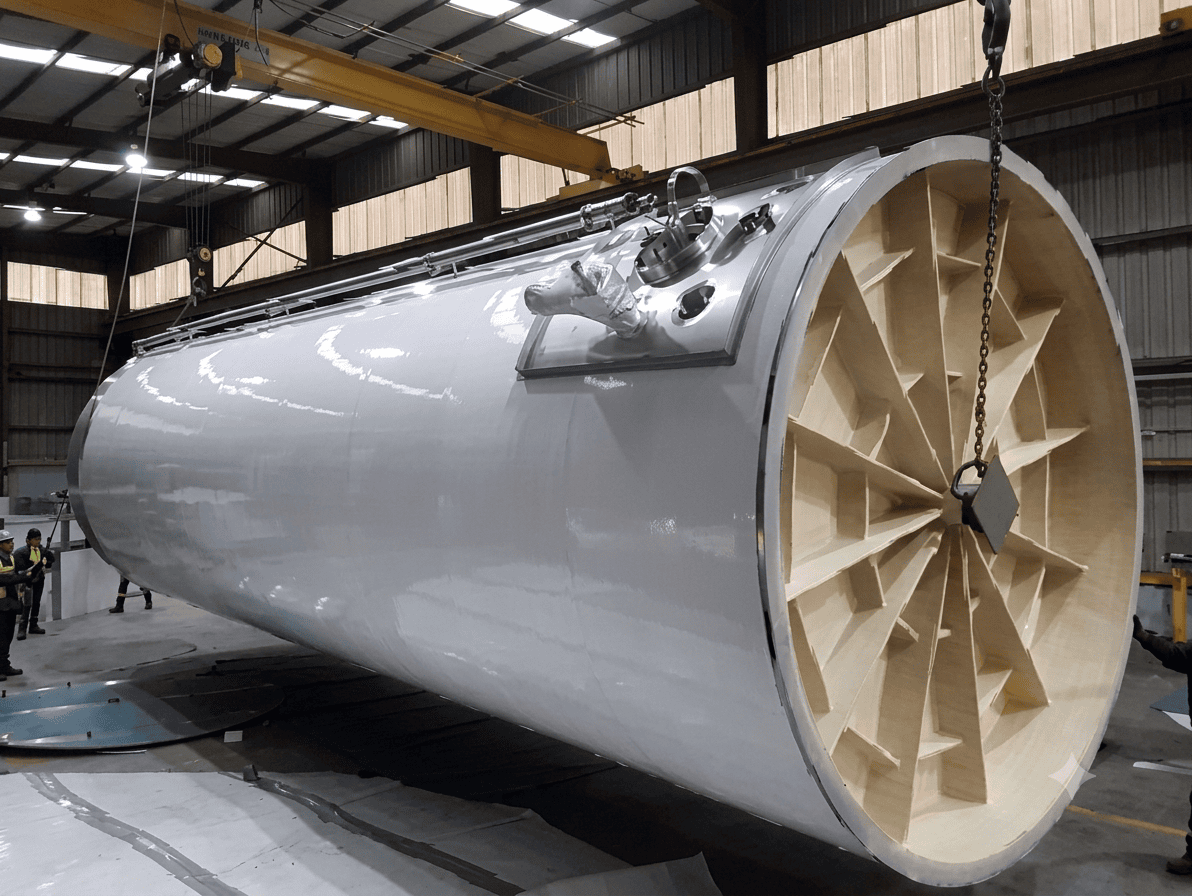
In the era of the smart factory, raw material storage is no longer a passive process. Industrial silos for powders, grains, and pellets are evolving into dynamic systems that provide real-time data, optimize logistics, and ensure operational safety.
Automation is not just a matter of convenience; it is a strategy to eliminate losses caused by inaccurate inventory calculations and prevent accidents in critical environments. At Falco Latino, we integrate the latest monitoring technologies into our stainless steel storage systems.
La gestión manual de silos, especialmente con polvos cohesivos o pellets higroscópicos, conlleva riesgos de puenteo, rat-holing y segregación. La automatización no solo se limita a abrir y cerrar válvulas; permite el monitoreo en tiempo real de la presión de compactación y la humedad interna. Al implementar sensores de nivel ultrasónicos y sistemas de pesaje de alta precisión integrados al PLC, se elimina el factor humano, estandarizando la dosificación y previniendo interrupciones críticas en la línea de suministro.
Unlike liquid fluids, bulk solids—such as plastic resin pellets, starch flours, or powdered chemical compounds—exhibit complex physical behaviors including mass flow, funnel flow, ratholing, particle segregation, and dangerous material bridging. The mechanical design of stainless steel silos must be paired with an advanced automation topology. This integration allows engineering teams to predict flow obstructions, calculate precise empty spaces based on the material's specific angle of repose, and eliminate variance within the plant's total mass balance.
Level Measurement Technologies: Non-Contact Precision
The era of manual plumb-bob measurements and mechanical rotary paddle switches—which frequently failed due to heavy material coating or physical shear stresses—is over. Today's industrial standards focus heavily on 80 GHz Radar systems and three-dimensional array scanning.
Advantages of High-Frequency Radar: Unlike legacy ultrasonic sensors, 80 GHz radar operates at short wavelengths that remain completely unaffected by dense suspended dust clouds generated during pneumatic conveying or silo filling cycles. Its ultra-narrow beam angle prevents false-echo reflections from internal structural obstacles such as ladders or tie-rods.
- 3D Surface Mapping Array: Crucial for large-diameter storage vessels where products form asymmetrical material cones or draw-down funnels. 3D acoustic or electromagnetic scanners measure multiple surface coordinates to compute actual material volume with high precision.
Load Cells and Real-Time Weighing
For process plants handling high-cost raw materials, volumetric estimations fall short. Direct gravimetric data is required to handle shrinkage tracking and rigid inventory audits.
- Continuous Gravimetric Weighing: Achieved by instrumenting structural load cells paired with self-centering mount assemblies underneath the silo's support legs or skirt. This framework outputs real-time net weight readouts independent of any changes in the product's apparent bulk density.
- High-Accuracy Automated Dosing: By networking load cell transmitters directly into Programmable Logic Controllers (PLCs), the silo operates actively, managing automated discharge via rotary airlocks, knife gate valves, or screw feeders into either dense or dilute phase pneumatic conveying lines.
Active Safety and Explosion Prevention (ATEX)
Storing organic, metallic, or chemical powders containing high concentrations of suspended fines introduces a critical hazard profile regarding combustible dust environments.
Deflagration Risk Mitigation: Modern industrial storage assets engineered by Falco Latino integrate intrinsically safe field instrumentation and control loops that monitor real-time safety variables, such as bearing temperatures, static charge dissipation, and internal vessel pressure.
Suppression and Isolation Infrastructure: Interfacing certified dust explosion venting panels, explosion isolation valves, and automatic nitrogen(N2)blanketing systems. These configurations actively suppress fire hazards by dropping oxygen levels below the Limiting Oxygen Concentration (LOC), strictly complying with NFPA 652 codes and ATEX Zona 20/21 industrial directives..
The Value of Data: Integration with ERP and SCADA
- Celdas de Carga: Instaladas en la estructura de soporte para un control preciso.
- Integración ERP/MES: Los datos deben fluir automáticamente hacia sus sistemas de gestión. Esto permite compras automatizadas y una trazabilidad total, desde la descarga hasta el mezclado final.
El silo inteligente actúa como un nodo de datos mediante protocolos como Profinet, Ethernet/IP o IO-Link.
Gestión Automatizada: El sistema genera alertas de reorden cuando los niveles caen por debajo de la reserva crítica.
Trazabilidad Total: La integración con SAP u Oracle permite consolidar consumos, mermas e inventarios en tiempo real.
Supervisión SCADA/HMI: Nuestras interfaces permiten monitorear de forma remota el estado estructural, el peso y el nivel de llenado desde cualquier dispositivo autorizado.
Para una automatización eficiente, es vital analizar la arquitectura del pesaje:
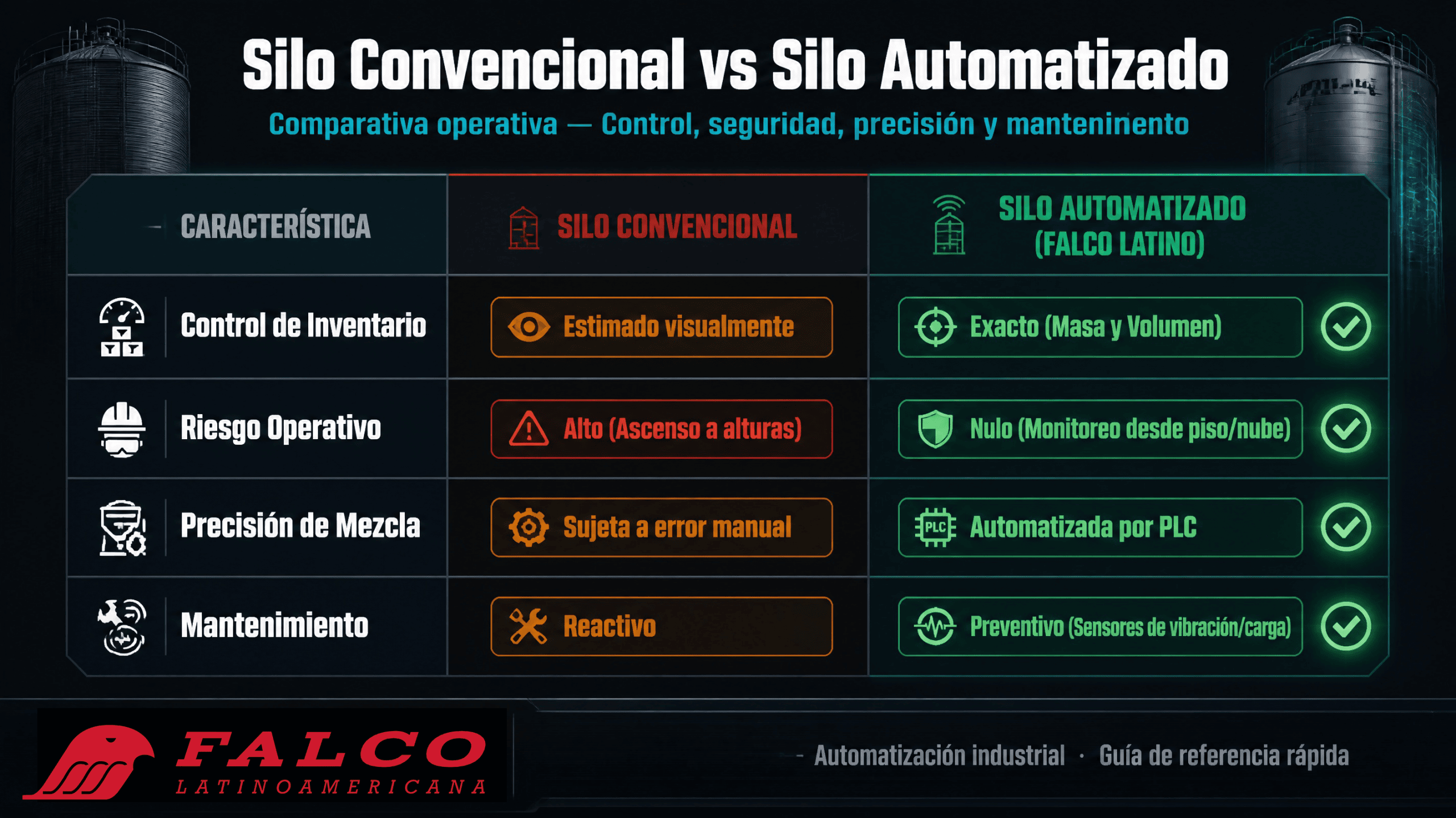
Para garantizar que la automatización sea eficiente, es imperativo analizar la arquitectura del sistema de pesaje:
High-Precision Load Cells: Integradas directamente en la estructura de soporte del silo para un control de inventario preciso.
Integración con ERP/MES: Los datos de inventario deben fluir automáticamente hacia sus sistemas de gestión, permitiendo órdenes de compra automatizadas y una trazabilidad total del lote desde la descarga del silo hasta el mezclado final.
Frequently Asked Questions
How do I prevent the accumulation of powders on the silo walls? Automation allows for controlled vibration cycles or scheduled compressed air fluidization, preventing compaction without compromising structural integrity.
Is it possible to automate existing silos? Yes, through the integration of instrumentation skids and adaptive control panels, we can modernize your current infrastructure to comply with Industry 4.0 standards.
Profitability Through Control
Silo automation is an investment that pays for itself by reducing waste, optimizing raw material purchasing, and ensuring a safe plant. At Falco Latino, we combine our expertise in stainless steel fabrication with the most advanced electronic engineering solutions available on the market.
Are you looking to modernize your storage system or planning a new silo project?
Our engineers can design a turnkey solution that includes everything from fabrication to software integration.