
Agitators and Mixing Systems

Systems designed to ensure homogeneous mixing, dispersion, emulsion or suspension depending on the type of product.
Benefits

Functionality / Applications

  • Mixture of liquid or solid ingredients.

  • Emulsions, dispersions, suspensions.

  • Food, cosmetic, pharmaceutical and chemical industries.

Types of agitators

a) Marine propeller

  • High efficiency
  • Axial flows → ideal for mixing low viscosity liquids
  • Widely used in food, chemicals and water

b) Turbines (Rushton, Pitch-blade, Hydrofoil)

  • Rushton: strong turbulence, gases and dispersion
  • Pitch-blade: axial flow, robust mixing
  • Hydrofoil: high energy efficiency

c) Anchor

  • For highly viscous fluids
  • Scrape the tank walls
  • Widely used in paints, cosmetics, gels

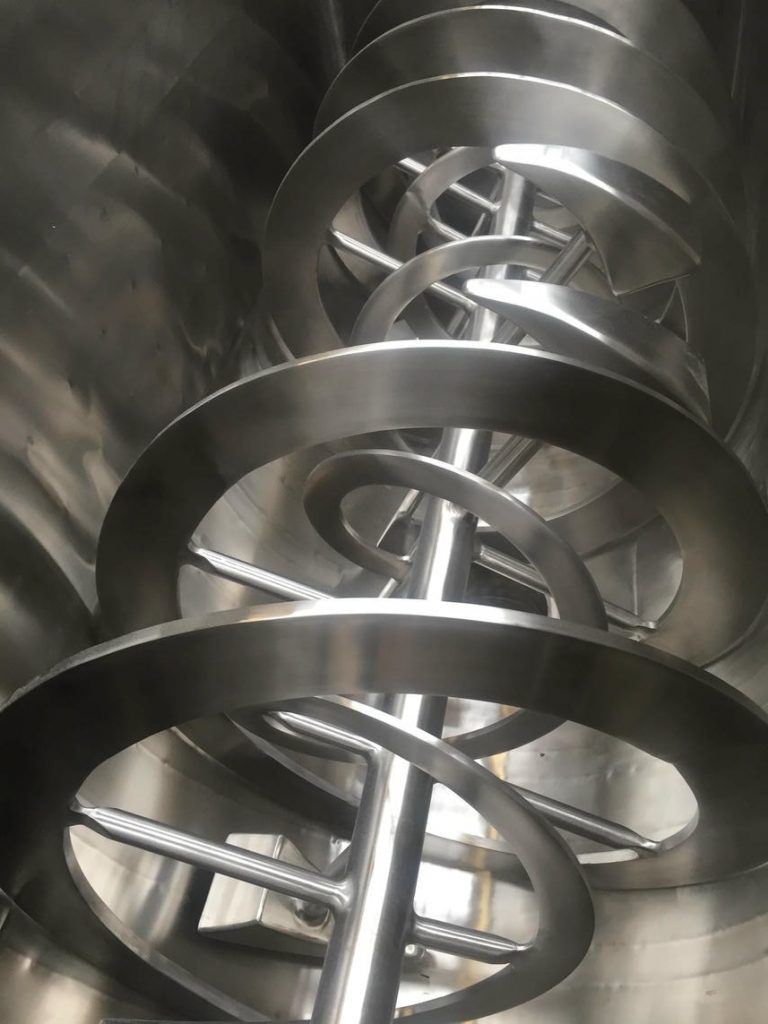
d) Helical propeller or helical tape

  • For extreme viscosities
  • Smooth but high-torque mix

e) Rotor–Stator (Homogenizers)

  • High shear
  • Emulsion and dispersion
  • Used in pharmaceuticals, cosmetics, dairy

a) Axial

  • Move the fluid from top to bottom
  • Ideal for clear and uniform liquids

b) Radial

  • Flow to the sides
  • Ideal for mixtures with solids, gases, or dispersions

c) Tangential

  • Circular flow
  • Good suspension in tanks without baffles

a) Mixture of liquids

  • Marine propeller
  • Axial turbine

b) Dispersion of solids

  • Radial turbine
  • Rushton

c) High viscosity mixture

  • Anchor
  • Helical

d) Emulsification

  • Rotor-stator

e) Suspension of solids

  • Inclined turbines
  • Hydrofoil

a) Plates

  • Metal plates stacked to form channels.
  • High efficiency, compact and easy to clean.
  • Used in food, pharmaceuticals and air conditioning.

b) Casing and tubes

  • Tubes inside a cylindrical casing.
  • Resistant to high pressures and temperatures.
  • Common in chemistry, petrochemicals, and energy.

c) Air-cooled

  • They use ambient air for cooling.
  • They incorporate fins to increase surface area.
  • Used in automotive and industrial refrigeration.

d) Concentric tubes

  • One tube inside another.
  • Simple, economical and for small flow rates.

a) With baffles

  • Avoid tangential flow
  • Increased efficiency

b) Without deflectors

  • Rotating motion
  • It requires specific agitators

a) High speed

  • Homogenizers
  • Dispersers
  • Rotor-stator

b) Low speed

  • Anchor
  • Helical
  • Smooth blend