
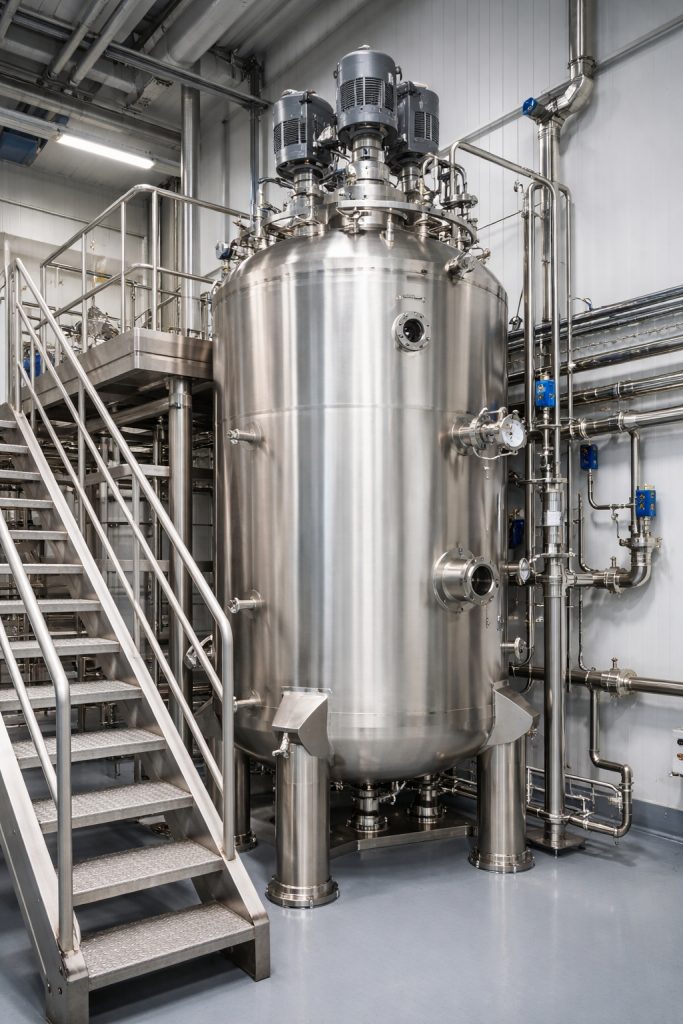
Falco industrial reactors are designed for complex processes requiring precise control of temperature, pressure, heat transfer, and agitation. Manufactured from food-grade, chemical, or pharmaceutical-grade stainless steel, they guarantee safety, efficiency, and reliability in every operation.
With over 30 years of experience and ASME certifications, we produce custom-made reactors, ready to be integrated into chemical, pharmaceutical, cosmetic and food production lines.
It is a three-bladed, curved agitator that generates a powerful and uniform axial flow. It is used when rapid mixing is required in low- to medium-viscosity liquids. Its design allows for the movement of large volumes with low energy consumption.
It features several straight or angled blades that push the fluid vertically. It is ideal for suspending solids, homogenizing ingredients, and maintaining a consistent mix without dead zones. It is used in chemical, food, and pharmaceutical processes.
It's a low-speed agitator that sweeps the tank walls to prevent the product from sticking or burning. Scrapers ensure a uniform temperature and are essential for viscous products such as creams, jams, gels, or emulsions.
A combination of two or three agitators working together: one high-speed, one low-speed, and one scraper. This allows for the processing of complex products that require different stages of mixing, dispersion, and homogenization within the same batch.
They prevent leaks between the shaft and the tank. The sanitary version is easy to disassemble and clean, while the industrial version is resistant to harsh chemicals. They are key to ensuring hygiene, operational safety, and preventing product contamination.
Fixed motors operate at a single speed; variable frequency drives allow the agitator speed to be adjusted according to the stage of the process. This improves control, reduces energy consumption, and prevents overmixing or damage to sensitive products.
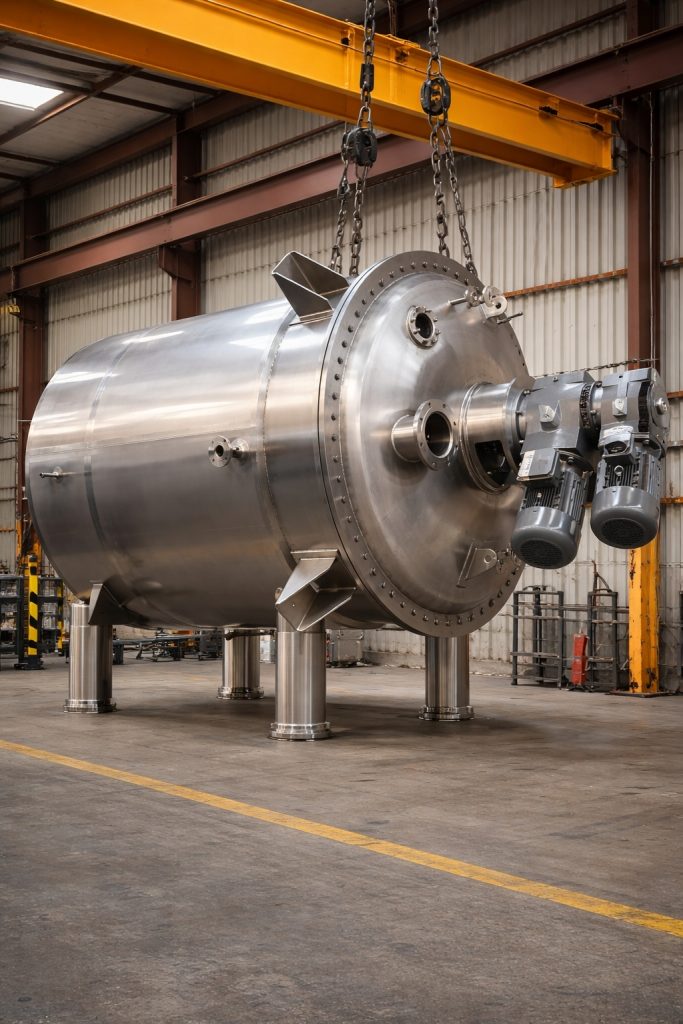
The tanks control the heat generated or required during the reaction thanks to integrated cooling or heating systems.
They comply with strict sanitary standards, allowing the mixing of active ingredients, excipients, and suspensions without risk of contamination.
They process creams, gels, shampoos, and emulsions that require controlled agitation and constant temperatures to maintain stability.
They allow control of oxygen, temperature and movement, critical conditions for microorganisms or enzymes.
Perfect for sauces, bases, jams, dressings, dairy products and syrups, where absolute hygiene is required.
High viscosity systems that require strong mixing, temperature control, and specific agitators.
Industrial reactors are classified according to how the reaction occurs , how the reactants are mixed , and how the process is operated . Each type serves specific applications depending on whether the reactants are in the gaseous, liquid, or solid phase, and the level of control required in the plant.
a) Reactors for homogeneous reactions
These are reactors where all reactants are in the same phase , either gas-gas or liquid-liquid. There is no phase separation, so the mixture is uniform and the reaction occurs evenly throughout the volume.
Typical applications:
Advantages:
b) Reactors for heterogeneous reactions
The reactants are in different phases (gas-liquid, liquid-solid, gas-solid, etc.). Mass transfer between phases is key for the reaction to occur.
Typical examples:
Advantages:
a) Perfectly mixed reactors (CSTRs)
The contents of the reactor are thoroughly mixed, so the composition and temperature are uniform throughout . The outgoing product has the same composition as the contents.
Typical uses:
Advantages:
b) Plug flow reactors (PFRs)
The reactants flow like a "piston," meaning they advance in a straight line without mixing laterally . Each "section" of the fluid is at a different stage of the reaction.
Typical uses:
Advantages:
a) Batch reactors
The reactor is initially loaded, allowed to react, and then unloaded. No material enters or leaves during the process.
Typical uses:
Advantages:
b) Semi-continuous reactors (Fed-Batch)
They combine batch feeding with progressive feeding:
Widely used in:
Advantages:
c) Continuous reactors
They operate without stopping:
They remain in a steady state.
Typical uses:
Advantages: