
Heat Exchangers

Equipment for the efficient transfer of heat between fluids, designed to suit each process.
Benefits

Functionality / Applications

  • Pasteurization.

  • Rapid heating or cooling.

  • Energy recovery.

  • Thermal control of reactors or kettles.

Types of heat exchangers

a) Direct

  • The fluids mix.
  • High thermal efficiency and compact design.
  • They are used only when the mixture does not cause problems.
    Example: cooling towers.

b) Indirect

  • The fluids do not mix; they are separated by a metallic surface.
  • They prevent contamination and allow for greater control.
  • The most commonly used in the industry.

a) Parallel

  • Both fluids circulate in the same direction.
  • Lower efficiency.

b) Counterflow

  • They flow in opposite directions.
  • The most efficient:allows for a greater temperature difference.

c) Crossed

  • Perpendicular flows.
  • Useful when one of the fluids changes phase.
  • It can be “mixed” or “unmixed”.

d) Combined

  • A fluid flows in both parallel and countercurrent directions at the same time.
  • Increases heat transfer.

a) Simple step

  • A single heat exchanger.
  • It can be complemented with several units in series.

b) Multiple steps

  • Several stages of exchange within the same team.
  • They increase efficiency and reduce space, common in "U" tubes.

a) Plates

  • Metal plates stacked to form channels.
  • High efficiency, compact and easy to clean.
  • Used in food, pharmaceuticals and air conditioning.

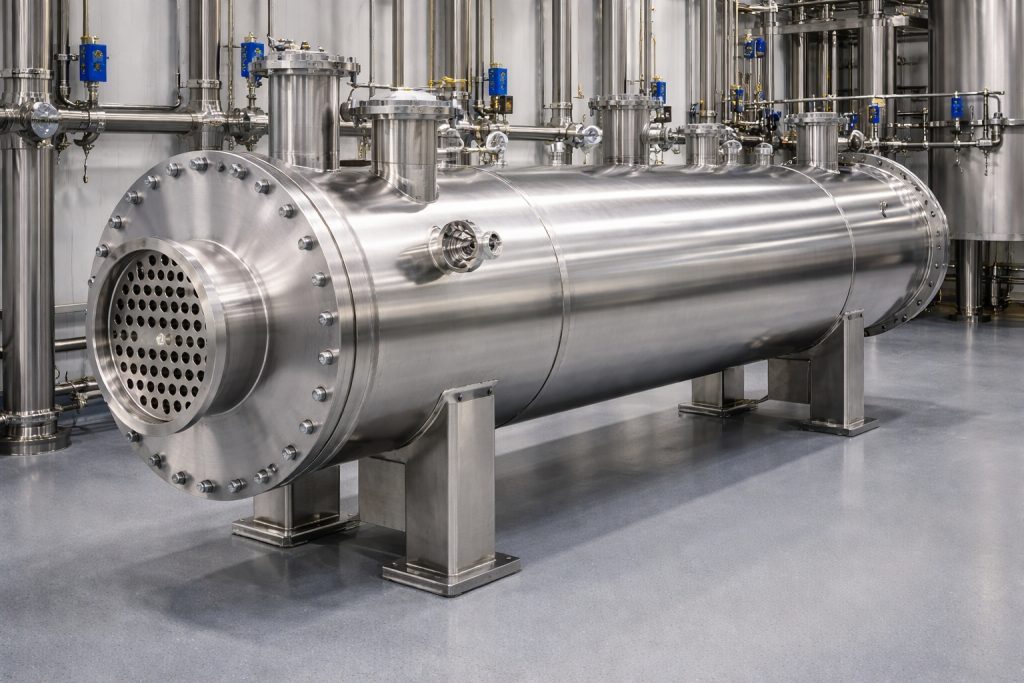
b) Casing and tubes

  • Tubes inside a cylindrical casing.
  • Resistant to high pressures and temperatures.
  • Common in chemistry, petrochemicals, and energy.

c) Air-cooled

  • They use ambient air for cooling.
  • They incorporate fins to increase surface area.
  • Used in automotive and industrial refrigeration.

d) Concentric tubes

  • One tube inside another.
  • Simple, economical and for small flow rates.